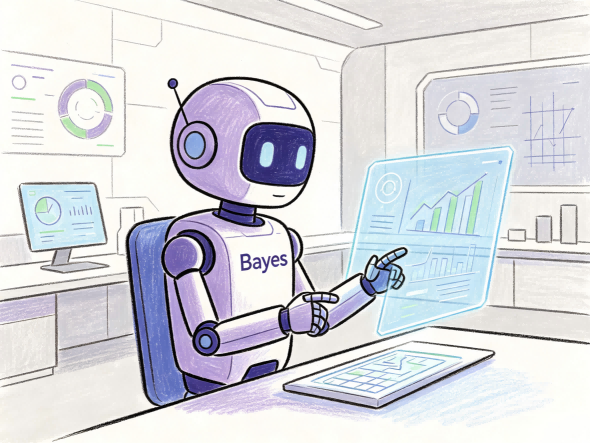
Most analytics workflows are still surprisingly manual
Modern companies generate enormous amounts of data, yet the path from raw information to an actual business decision remains far more manual than most people realize.
A typical analytics workflow still looks something like this: data gets exported from different systems, cleaned inside spreadsheets or Python notebooks, transformed through SQL queries, visualized in BI tools, summarized in reports, and finally translated into recommendations during meetings or presentations. Even in technically sophisticated organizations, analysis is often fragmented across multiple tools, teams, and layers of interpretation.
What makes the process especially inefficient is not any individual step. It is the accumulation of small operational frictions across the entire pipeline.
A dataset arrives with inconsistent formatting. Someone manually fixes schema issues. Metrics need to be redefined because business logic changed. Dashboards break after new columns appear. Reports become outdated as soon as fresh data enters the system. Analysts spend hours rebuilding workflows that technically already existed the week before.
Over time, data analysis starts to resemble maintenance work as much as analytical work.
This is one of the reasons many organizations struggle to scale decision-making despite investing heavily in modern data infrastructure. The bottleneck is no longer collecting data. The bottleneck is moving efficiently from raw data to reliable understanding.
The Missing Layer in Modern Analytics
Most analytics tools solve isolated parts of the workflow.
Databases store information. ETL systems move it. BI platforms visualize it. AI copilots help generate SQL or answer questions. But the overall analytical process still depends heavily on humans stitching these systems together.
That gap becomes obvious whenever business questions are ambiguous.
A team investigating declining conversion rates rarely starts with a perfectly defined hypothesis. The analysis usually evolves dynamically: first identifying anomalies, then comparing dimensions, validating assumptions, exploring behavioral patterns, and eventually narrowing toward a likely explanation.
Traditional analytics stacks were not designed for this kind of fluid reasoning process. They were designed for querying known metrics inside relatively stable environments.
This is where AI-native analytical agents are beginning to introduce a different model.
Instead of treating analysis as disconnected tasks, these systems attempt to orchestrate the entire analytical lifecycle continuously, from raw ingestion to final interpretation.
BayesLab is built around this exact idea.
BayesLab Treats the Entire Analytics Pipeline as One System
What makes BayesLab interesting is not simply that it uses AI for analytics. Many products already do that.
The more meaningful distinction is that BayesLab treats every stage of analysis as part of the same connected workflow rather than separate operational steps handled manually across different tools.
Once users upload raw data, the system automatically cleans, structures, analyzes, and interprets it without requiring separate workflows for preprocessing, chart generation, reporting, or dashboard construction.
Instead of stopping at "AI-generated insights," the platform moves through the full analytical pipeline:
It interprets schema relationships, performs multi-dimensional exploratory data analysis, identifies anomalies and root causes, generates visualizations, drafts reports, produces recommended actions, and continuously refreshes outputs as new data arrives.
In traditional environments, a report often becomes detached from the underlying workflow the moment it is exported. Dashboards drift away from evolving business definitions. Charts get recreated manually for presentations. Teams repeatedly rebuild analysis because outputs exist as disconnected snapshots rather than living systems.
BayesLab approaches the problem differently. By treating outputs as continuously updating components within the same analytical environment, the system reduces the amount of manual reconstruction required every time data changes.
The result is not just faster analysis. It is a more continuous form of analysis.
From Raw Data to Presentation-Ready Outputs
One of the more overlooked problems in analytics is that generating insights is only part of the work.
Insights still need to be communicated.
A large portion of analytical effort inside organizations goes into transforming technical findings into presentation-ready materials that executives, clients, or operational teams can actually understand. Charts need refinement. Reports need structure. Conclusions need context. Recommendations need prioritization.
This translation layer is often where workflows slow down dramatically.
BayesLab attempts to compress that entire cycle into a unified process. Rather than requiring separate tools for exploration, visualization, reporting, and dashboard updates, the platform generates outputs designed to move directly into operational use.
Reports are structured. Visualizations are immediately usable. Dashboards refresh automatically as new datasets enter the system.
That seemingly simple capability changes the rhythm of analytics inside organizations. Teams spend less time rebuilding deliverables and more time evaluating decisions.
In effect, the analytical pipeline becomes persistent rather than episodic.
The Future of Analytics May Be Autonomous End-to-End Systems
For years, analytics software evolved by adding layers of abstraction on top of data infrastructure. Dashboards simplified reporting. No-code tools simplified querying. AI copilots simplified interaction.
AI agents introduce something fundamentally different: the possibility of automating the analytical process itself.
The long-term shift is not simply toward faster charts or easier SQL generation. It is toward systems capable of handling the full lifecycle of analysis autonomously, from raw ingestion to continuously updating business interpretation.
That is the direction products like BayesLab point toward.
Not another dashboard layer.
But a continuously operating analytical system that transforms messy raw data into structured, presentation-ready, decision-oriented outputs with minimal human coordination.
And as data environments continue becoming more complex, that capability may move from competitive advantage to operational necessity far faster than most organizations expect.
Try Bayeslab for Free and experience Agentic Data Analysis today.