For years, the conversation around data analytics has largely focused on infrastructure. Companies invested heavily in cloud warehouses, visualization platforms, ETL pipelines, and business intelligence systems with the expectation that better tooling would naturally lead to better decisions. In many ways, that investment worked. Data became easier to store, easier to query, and significantly more accessible across organizations.
Yet despite the maturity of the modern analytics stack, a surprisingly large amount of analytical work still depends on manual effort. Raw datasets often arrive incomplete or inconsistently formatted. Analysts spend hours cleaning fields, validating schema assumptions, comparing dimensions, rebuilding dashboards, and translating technical findings into language business teams can actually use. Even organizations with sophisticated data infrastructure frequently struggle with the operational gap between “having data” and “acting on data.”
This gap becomes even more visible as the volume and complexity of information continue to increase. Modern teams are no longer analyzing a handful of monthly reports. They are dealing with continuously updating streams of operational, financial, marketing, and product data, often across disconnected systems. The challenge is no longer access to information. It is the ability to transform unstructured or imperfect data into reliable decisions quickly enough to matter.
That shift is creating a new category of AI-native analytical systems, designed not simply to answer questions about data, but to participate directly in the analytical process itself.
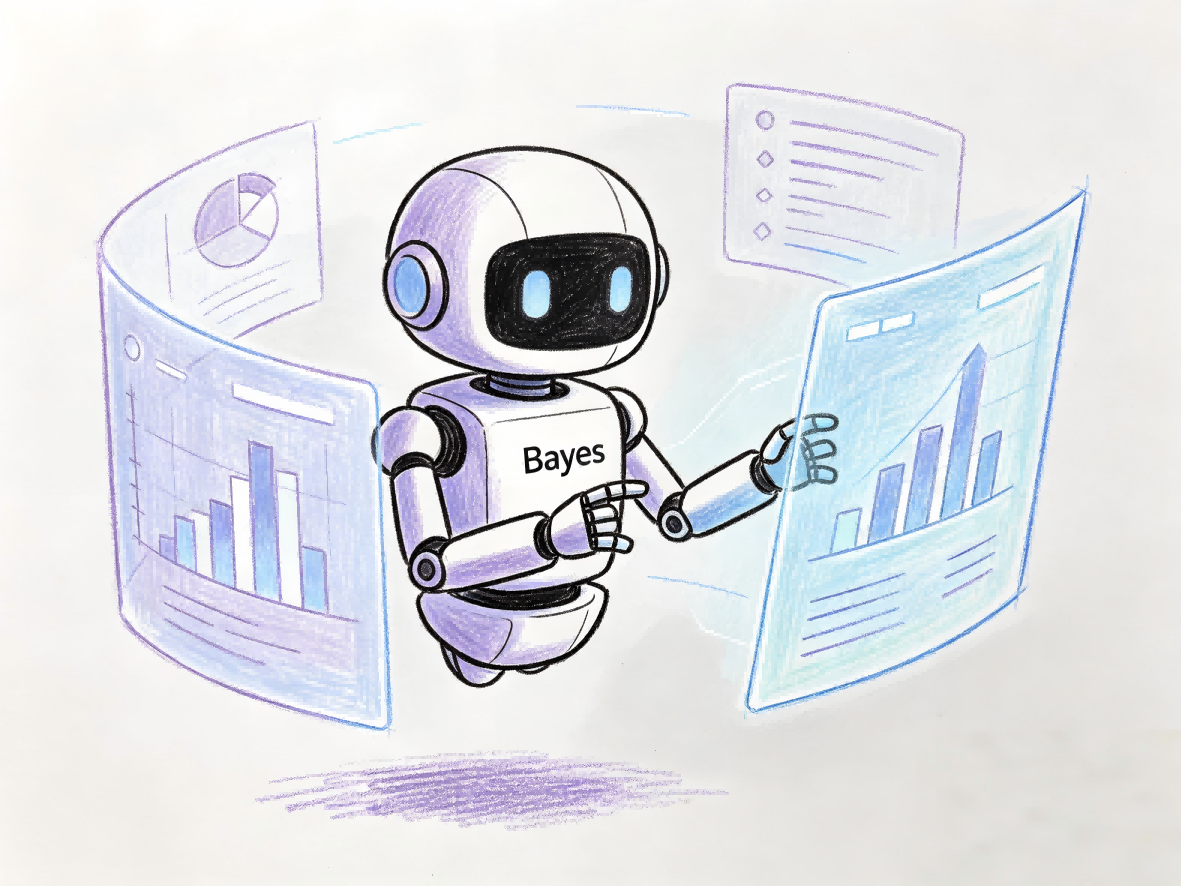
BayesLab is part of this emerging category, though its approach differs from many of the AI analytics tools currently entering the market. Rather than positioning AI as a conversational layer on top of dashboards or databases, BayesLab treats analysis as a connected workflow that extends from raw data ingestion to presentation-ready outputs.
When users upload data into the system, the platform does not stop at generating isolated charts or one-time summaries. It automatically handles data cleaning, structural interpretation, exploratory analysis, visualization generation, and report creation within the same analytical flow. More importantly, these outputs remain connected to one another. Reports, dashboards, charts, and recommendations are treated as persistent analytical artifacts rather than disposable responses generated inside a chat window.
In practice, real-world analysis rarely happens in a single step. Business questions evolve while analysis is taking place. Teams refine assumptions, compare dimensions, investigate anomalies, and revisit conclusions as new information arrives. A useful analytical system therefore needs continuity, not just responsiveness.
That continuity becomes especially important in environments where data quality is inconsistent or requirements are initially vague. A marketing team investigating declining conversion rates may not know which variable caused the shift. An operations team may recognize a performance issue without understanding whether the root cause is geographic, behavioral, seasonal, or technical. In these situations, analysis depends less on retrieving predefined answers and more on navigating uncertainty systematically.
This is where AI agents begin to offer a meaningful advantage over traditional analytics workflows. By maintaining context across multiple stages of reasoning, systems can move beyond static querying toward iterative analytical exploration. Root cause analysis, dimensional exploratory data analysis, predictive modeling, and automatically updating reports become part of a continuous process rather than isolated technical tasks.
BayesLab appears designed with this broader analytical lifecycle in mind. The platform emphasizes reproducibility and structured workflows in addition to automation speed, which is an important distinction in professional environments. While rapid generation is valuable, organizations ultimately care about consistency and reliability. Analytical outputs that change unpredictably across refresh cycles are difficult to operationalize, regardless of how impressive the underlying AI may appear during demonstrations.
For this reason, one of the more interesting aspects of AI-native analytics platforms may not be their ability to generate insights instantly, but their ability to reduce operational friction around analysis itself. When reports, dashboards, and recommendations can refresh automatically as new data arrives, teams spend less time rebuilding workflows manually and more time evaluating strategic decisions. Analysis gradually shifts from being a periodic reporting exercise into a continuously updating layer of operational intelligence.
This transition also reflects a broader evolution in enterprise software. Earlier generations of analytics tools primarily improved visibility into historical performance. Newer AI-driven systems are beginning to support reasoning, interpretation, and recommendation as integrated capabilities rather than separate workflows handled by different teams.
However, the direction is becoming increasingly clear. The future of analytics may depend less on who can build the most dashboards, and more on who can build systems capable of transforming raw, ambiguous data into reliable and continuously evolving decision frameworks.
In that sense, products like BayesLab represent more than workflow automation. They point toward a different model of analytics altogether, one where the distance between raw data and actionable understanding becomes dramatically smaller.
Try Bayeslab for Free and experience Agentic Data Analysis today.