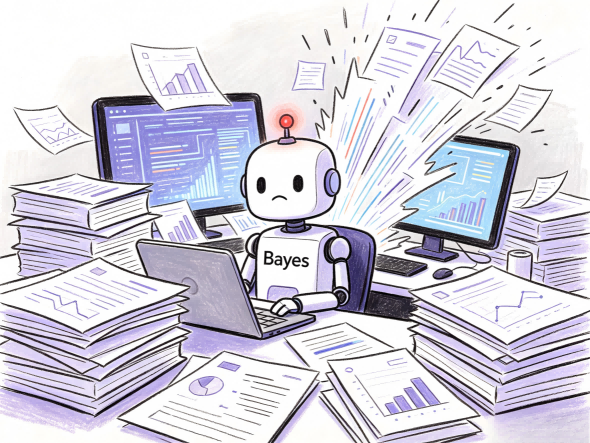
For more than two decades, the analytics industry has focused on making data more accessible. Data warehouses made storage cheaper. Business intelligence platforms made visualization easier. Cloud infrastructure made computation scalable. More recently, large language models introduced natural language interfaces that allow users to query data conversationally.
Each of these advances reduced friction, but none fundamentally changed the way analytical work is performed.
Behind nearly every report, dashboard, or executive presentation, there is still a sequence of manual steps that must be completed before insights can be generated. Data needs to be cleaned, schemas need to be understood, metrics need to be defined, anomalies need to be investigated, visualizations need to be created, and findings need to be translated into narratives that stakeholders can act upon. While the interfaces have evolved dramatically, the underlying workflow remains largely unchanged.
This is why many organizations continue to experience a paradox. They have more data than ever before, more analytics tools than ever before, and more dashboards than ever before. Yet turning information into decisions remains surprisingly slow.
The challenge is no longer access to data. The challenge is analytical execution.
Analytics Was Never a Single Query
The recent rise of ChatBI products has introduced an important shift in how users interact with data. Instead of navigating complex dashboards or writing SQL, users can simply ask questions in natural language and receive answers instantly. This represents a meaningful improvement in usability, particularly for non-technical teams.
However, real-world analysis rarely consists of a single question followed by a single answer.
When experienced analysts investigate a business problem, they do not begin with certainty. They start with ambiguity. A decline in conversion rate, a spike in churn, or an unexpected change in revenue often requires multiple stages of investigation before a credible conclusion can be reached. Data quality issues need to be identified. Relevant dimensions must be explored. Hypotheses are formed and tested. Alternative explanations are evaluated. Findings are synthesized into a coherent narrative.
In other words, analysis is not a query. It is a process.
The distinction matters because answering questions and conducting investigations require fundamentally different systems. A conversational interface can retrieve information that already exists. An analytical workflow must generate understanding that does not yet exist.
As organizations increasingly seek to democratize access to analytics, this gap becomes more visible. The people who need insights most are often not analysts. They are founders, operators, marketers, product managers, consultants, and executives. What they need is not another tool for querying data. What they need is a reliable mechanism for transforming raw information into actionable understanding.
The Shift from Analytical Tools to Analytical Agents
Historically, software has functioned as an instrument. Users provide instructions and software executes them. In analytics, this paradigm has persisted for decades. Whether using spreadsheets, SQL editors, BI platforms, or modern AI copilots, users remain responsible for orchestrating the analytical process.
Agentic systems invert that relationship.
Instead of asking users to define every step, an agent assumes responsibility for achieving an outcome. The system determines what analyses should be performed, what data transformations are necessary, what visualizations best communicate findings, and how results should be structured for decision-making.
This shift is particularly important in analytics because analytical workflows are inherently multi-step and interdependent. A meaningful conclusion is often the result of dozens of intermediate decisions that occur long before a chart is produced. Automating only the final interaction layer leaves most of the complexity untouched. Automating the workflow itself changes the economics of analysis entirely.
Building BayesLab
BayesLab was built around a simple observation: most people who need analysis are not interested in performing analysis.
Their objective is not to clean datasets, debug SQL queries, configure dashboards, or manually assemble presentation decks. Their objective is to understand what is happening, why it is happening, and what actions should be taken next.
To support that outcome, we designed BayesLab as an autonomous AI analyst rather than a reporting tool.
Users upload raw data and provide a business question, often with incomplete requirements and imperfect datasets. BayesLab interprets schemas, performs data preparation, explores relevant dimensions, identifies patterns and anomalies, conducts root-cause analysis, generates forecasts where appropriate, and produces a structured report that combines visualizations, findings, and recommendations.
Importantly, the output is not limited to analytical results. Communication is a critical component of decision-making, which is why BayesLab automatically generates presentation-ready deliverables alongside the underlying analysis. Reports, charts, dashboards, and slide decks are treated as connected artifacts within a single analytical workflow rather than isolated outputs generated by separate tools.
This architectural choice enables a capability that traditional reporting systems struggle to provide: reproducibility.
When new data becomes available, users can rerun the entire analytical workflow rather than rebuilding reports from scratch. The same methodology, assumptions, and narrative structure can be applied automatically to updated datasets, allowing insights to evolve as the underlying business changes.
From Reports to Analytical Infrastructure
One of the most overlooked inefficiencies in modern organizations is that analytical work is frequently recreated rather than reused.
Teams spend weeks producing reports that become outdated within days. Analysts repeatedly execute similar workflows against new datasets. Business stakeholders continuously request refreshed versions of analyses that have already been performed multiple times before.
This pattern exists because reports are typically treated as static outputs rather than reusable systems.
We believe that AI creates an opportunity to rethink this model. Instead of generating isolated reports, organizations can create analytical workflows that persist over time. Analysis becomes repeatable. Insights become refreshable. Knowledge becomes cumulative.
In this model, the value of an analytical system is not measured by how quickly it produces a chart. It is measured by how effectively it transforms new information into updated understanding.
That transition, from static reporting to dynamic analytical infrastructure, may ultimately be the most important change AI brings to the analytics industry.
Looking Ahead
The long-term opportunity in analytics is not making dashboards easier to use. It is making high-quality analysis universally accessible.
For decades, deep analytical work has been constrained by technical skills, specialized expertise, and limited organizational bandwidth. As AI systems become increasingly capable of reasoning across data, many of these constraints begin to disappear.
The result is not the elimination of analysts. Instead, it is the expansion of analytical capacity across entire organizations. Analysts spend less time assembling reports and more time tackling strategic questions. Business teams gain direct access to sophisticated analytical capabilities without requiring extensive technical training. Decision-making becomes faster because understanding can be generated at the speed of data itself.
At BayesLab, we believe the future of analytics will be defined not by better dashboards or more conversational interfaces, but by autonomous systems capable of conducting complete analytical workflows from raw data to decision-ready outcomes.
The future of analytics is not simply AI-assisted analysis.
Try Bayeslab for Free and experience Agentic Data Analysis today.