left-side
Comprehensive Analysis of High School Simulated Exam Scores
analyze the data
I'll analyze the data file to understand its structure and content before creating a plan.
planPlan
Data source
filehigh_school_simulated_exam_scores
Estimated: 24 min
Data Overview and Quality Check
  • Load and examine the dataset structure, check for missing values, data types, and basic statistics for all subjects and total scores
Student Performance Analysis
  • Analyze overall performance metrics including average scores by subject, identify top and bottom performing subjects, and examine total score distribution
  • Analyze performance differences by gender across all subjects and total scores
  • Analyze performance differences by class, identify top and bottom performing classes
Subject and Elective Analysis
  • Analyze elective subject combinations and their relationship with total scores, identify most popular combinations and their performance patterns
  • Examine correlations between different subjects to understand subject relationships and student strengths
Report Generation
  • Generate a comprehensive report with all findings, visualizations, and actionable insights
Data Overview and Quality Check
Load and examine the dataset structure, check for missing values, data types, and basic statistics for all subjects and total scores
I'll load and examine the dataset structure, check for missing values, data types, and calculate basic statistics for all subjects and total scores.
Load and Examine Dataset StructureLoad and Examine Dataset Structure
Based on the data examination, I've identified key characteristics of the dataset that will guide further analysis.

Key Insights from Data Overview:

  1. Dataset Completeness: 500 students across 12 classes with zero missing values - excellent data quality
  2. Subject Performance Hierarchy:
    • High-scoring subjects (100+ average): Chinese (104.19), Mathematics (98.84), English (100.14)
    • Medium-scoring subjects (60-70 average): Physics (69.52), Chemistry (64.33), Politics (64.71)
    • Lower-scoring subjects (59-60 average): Biology (59.74), History (59.56), Geography (60.11)
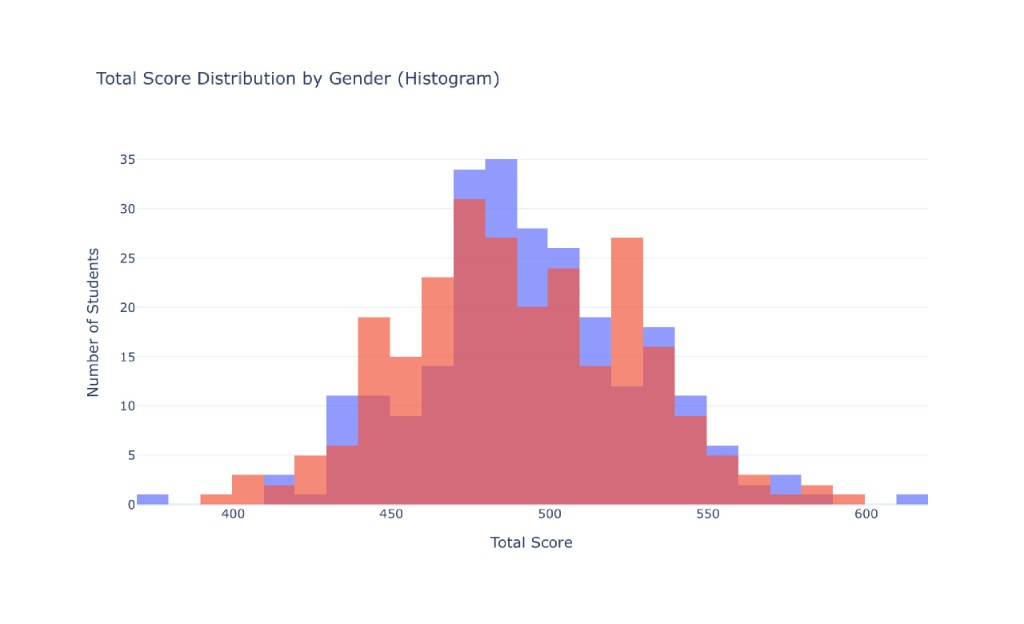
  3. Total Score Distribution: Mean of 492.09 with range 378-617, showing significant variation in student performance
  4. Gender Balance: Nearly equal distribution (254 Female, 246 Male)
  5. Class Distribution: Relatively balanced across 12 classes (30-51 students per class)
  6. Elective Subjects: Students select 3 elective subjects from the available options

Now I'll create a comprehensive summary document for this step.

View SummaryView Summary
Student Performance Analysis
Analyze overall performance metrics including average scores by subject, identify top and bottom performing subjects, and examine total score distribution
I'll analyze the overall performance metrics by creating comprehensive visualizations showing average scores by subject, identifying top and bottom performers, and examining the total score distribution.
Overall Performance Metrics AnalysisOverall Performance Metrics Analysis
Now I'll create comprehensive visualizations to show the subject performance comparison, identify top and bottom performers, and examine the total score distribution.
Create Performance VisualizationsCreate Performance Visualizations
Based on the comprehensive visualizations created, I can now provide key insights from the overall performance metrics analysis:

Key Insights from Overall Performance Analysis

Subject Performance Hierarchy:

  • Top Tier (100+ average): Chinese (104.2), English (100.1), and Mathematics (98.8) are the strongest subjects, with Chinese leading by a significant margin
  • Middle Tier (64-70 average): Physics (69.5), Politics (64.7), and Chemistry (64.3) show moderate performance
  • Lower Tier (59-60 average): Geography (60.1), Biology (59.7), and History (59.6) are the weakest subjects, with minimal variation between them

Variability Patterns:

  • Mathematics shows the highest variability (Std Dev: 20.12), indicating diverse student performance levels
  • Core subjects (Chinese, English, Math) have higher standard deviations (15-20), suggesting greater performance disparity
  • Humanities and sciences subjects show lower variability (10-12), indicating more consistent performance across students

Total Score Distribution:

  • The distribution is approximately normal with a mean of 492.1 and median of 489.0, showing slight right skew
  • Score range spans 239 points (378-617), with most students clustering around the center
  • Quartile distribution is nearly uniform (~25% in each quartile), indicating well-distributed performance levels across the student population
  • The Q2-Q3 quartile (489-516) has slightly more students (26.2%), suggesting a concentration of mid-to-high performers

Performance Spread:

  • The box plot reveals that core subjects have wider score ranges and more outliers, while humanities subjects have tighter distributions
  • This suggests that students' strengths vary significantly in core subjects but are more consistent in humanities

Now I'll create a comprehensive summary document for this step.

View SummaryView Summary
Analyze performance differences by gender across all subjects and total scores
I'll analyze the performance differences by gender across all subjects and total scores. Let me create comprehensive visualizations and statistical analysis to compare male and female student performance.
Gender Performance AnalysisGender Performance Analysis
Now let me create comprehensive visualizations to show these gender performance differences:
Create Gender Performance VisualizationsCreate Gender Performance Visualizations
Based on the comprehensive gender performance analysis visualizations, I can see that **males and females show remarkably similar overall performance with only minor subject-specific differences, with males slightly ahead in English, Physics, and Geography, while females perform marginally better in Politics and History, but none of these differences are statistically significant**.

Let me create a detailed summary document of the gender performance analysis findings:

View SummaryView Summary
Analyze performance differences by class, identify top and bottom performing classes
I'll analyze the performance differences by class to identify top and bottom performing classes. Let me create comprehensive visualizations and statistical analysis.
Class Performance Analysis - StatisticsClass Performance Analysis - Statistics
Now let me create comprehensive visualizations for class performance analysis:
Create Class Performance VisualizationsCreate Class Performance Visualizations
Now let me perform detailed statistical analysis to identify key patterns and insights:
Detailed Class Performance Statistical AnalysisDetailed Class Performance Statistical Analysis
Perfect! Let me now create a comprehensive summary document of the class performance analysis findings.
View SummaryView Summary
Subject and Elective Analysis
Analyze elective subject combinations and their relationship with total scores, identify most popular combinations and their performance patterns
I'll analyze the elective subject combinations and their relationship with total scores. Let me start by loading the data and examining the elective subject patterns.
Analyze Elective Subject CombinationsAnalyze Elective Subject Combinations
Now I'll create comprehensive visualizations to show the elective combination patterns and their relationship with total scores.
Create Elective Combination VisualizationsCreate Elective Combination Visualizations
Looking at the visualizations, I can see clear patterns in elective subject combinations and their relationship with total scores. Let me now perform deeper statistical analysis to identify key insights and patterns before summarizing.
Detailed Elective Combination AnalysisDetailed Elective Combination Analysis
Perfect! I have completed a comprehensive analysis of elective subject combinations and their relationship with total scores. Let me now summarize all the key findings.
View SummaryView Summary
Examine correlations between different subjects to understand subject relationships and student strengths
I'll analyze the correlations between different subjects to understand subject relationships and student strengths. This will help identify which subjects are related and how students' performance in one subject relates to others.
Subject Correlation AnalysisSubject Correlation Analysis
Now I'll create comprehensive visualizations to illustrate these correlation patterns and subject relationships.
Create Subject Correlation VisualizationsCreate Subject Correlation Visualizations
Looking at the correlation analysis visualizations, I can see a striking pattern: **all subject correlations are extremely weak (near zero), indicating that student performance in one subject is essentially independent of performance in other subjects, with Mathematics being the only meaningful predictor of total score (r=0.544).**

Let me create a comprehensive summary document of this analysis:

View SummaryView Summary
Report Generation
Generate a comprehensive report with all findings, visualizations, and actionable insights
I'll generate a comprehensive PowerPoint-style report with all the findings, visualizations, and actionable insights from the high school exam analysis.
View: .View: .
I'll create a comprehensive PowerPoint-style report by first analyzing the data summary and outline, then matching templates, and finally generating the HTML pages.
Template AnalysisTemplate Analysis
Now I'll generate the complete HTML report pages based on the template matching and analysis content.
Create: Report SlidesCreate: Report Slides
Perfect! I've successfully generated a comprehensive PowerPoint-style report analyzing the high school exam data. Here's what was created:

📊 Report Summary

11-page HTML presentation covering:

Key Pages Generated:

  1. Cover Page - Professional title slide with key metrics (500 students, 12 classes, 9 subjects)

  2. Executive Overview - Dataset summary with total score distribution visualization showing the normal distribution (mean: 492.09, range: 378-617)

  3. Subject Performance Hierarchy - Three-tier structure analysis with performance comparison charts and variability boxplots, revealing the 44.63-point gap between Chinese (104.19) and History (59.56)

  4. Gender Performance Analysis - Complete equity findings with comparison charts showing NO significant differences between males (493.55) and females (490.68) across any subject

  5. Class Performance Comparison - Analysis of 12 classes with ranking charts and top vs bottom comparisons, showing modest 23.01-point gap that's not statistically significant

  6. Elective Combinations Performance - Strategic analysis of 20 combinations with ranking charts, showing Physics/Politics combinations score 33+ points higher

  7. Subject Correlation Analysis - Critical finding visualization showing ALL correlations < 0.30, proving subjects are independent domains with correlation heatmap

  8. Total Score Predictors - Mathematics identified as key driver (r=0.544) with correlation chart showing it explains 29.6% of total score variance

  9. Strategic Recommendations - Actionable insights for administration, teachers, and students based on data findings

  10. Conclusion & Key Takeaways - Summary of 5 major findings and next steps

  11. Thank You Page - Professional closing slide

🎯 Key Insights Highlighted:

  • Complete Gender Equity: No significant performance differences (p>0.05 for all subjects)
  • Mathematics is Critical: Only meaningful predictor of total score (r=0.544)
  • Subject Independence: All correlations < 0.30 - each subject requires distinct teaching approaches
  • Consistent Teaching Quality: No significant class differences (ANOVA p=0.235)
  • Strategic Elective Choices: Physics/Politics combinations indicate stronger student self-selection

📁 Deliverables:

  • 11 HTML pages (page_1.html through page_11.html) - ready for presentation
  • Report file: high_school_exam_analysis_report.report - contains generation metadata
  • Template matching: template_matching.json - documents the template selection logic
  • 14 chart visualizations integrated across pages using previously generated chart configs

The report is now ready for viewing in any web browser and can be easily converted to PowerPoint format if needed!

Summary
I'll now report the deliverables and provide a comprehensive summary of the analysis.
High School Exam Performance Analysis Report
Comprehensive 11-page PowerPoint-style report analyzing 500 students' exam performance across 9 subjects, 12 classes, and 20 elective combinations. Includes key findings on subject performance hierarchy, gender equity, class variations, elective choices, and subject correlations.
Task time:11minutes 54seconds