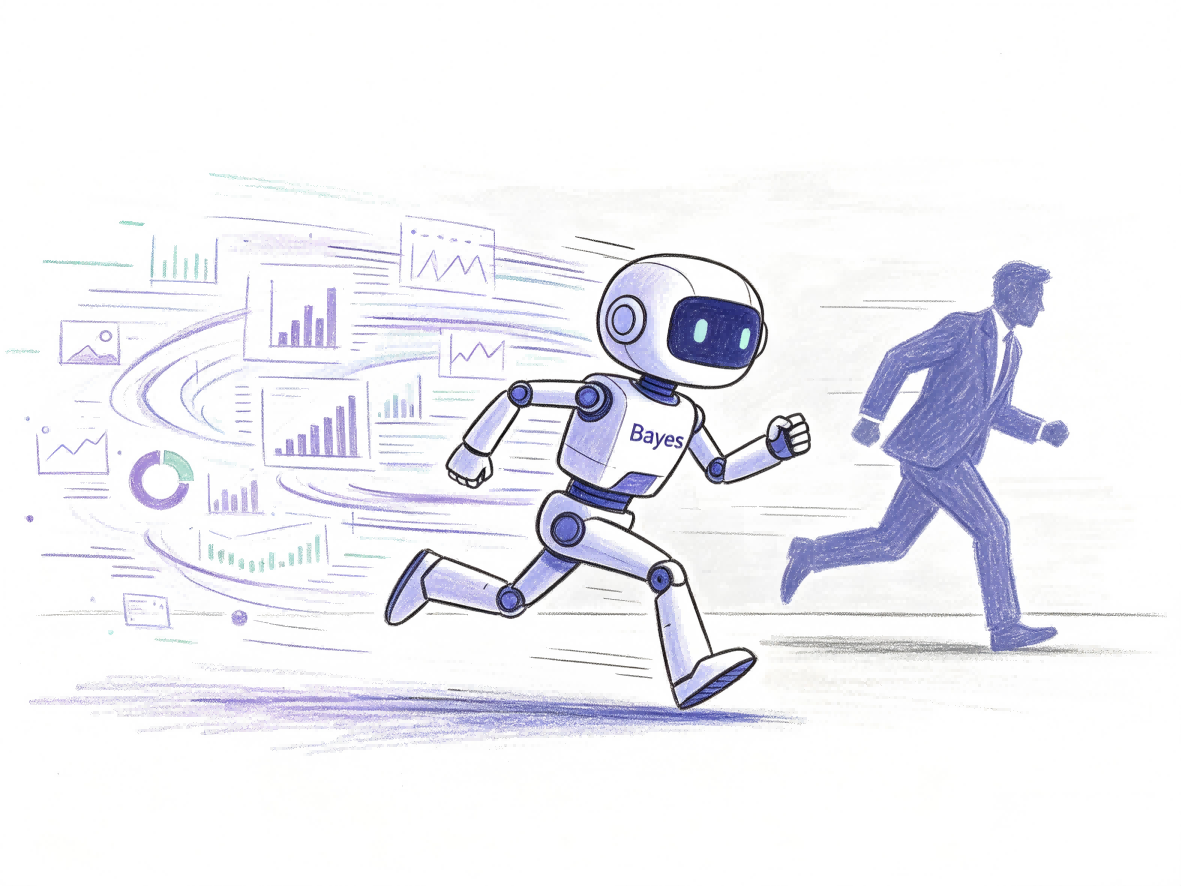
For the last twenty years, the analytics industry has largely focused on helping people access information. Every generation of software promised to make data more available than the one before it. We moved from spreadsheets to databases, from databases to business intelligence platforms, from business intelligence platforms to self-service dashboards, and more recently to conversational AI interfaces capable of querying data through natural language. While each wave improved accessibility, they all shared a surprisingly similar assumption: that once information became easier to retrieve, understanding would naturally follow.
In practice, that assumption turned out to be incomplete.
Organizations today are drowning in information. Revenue dashboards update in real time. Product teams monitor thousands of events. Marketing departments can attribute campaigns across dozens of channels. Customer support platforms record every interaction. Yet despite unprecedented visibility into operations, a familiar problem continues to surface inside nearly every company: important decisions still take too long to make.
The bottleneck is no longer access to data. The bottleneck is the analytical work required to transform data into understanding.
When executives ask why conversion rates declined, they are rarely asking for a chart. When product teams investigate retention issues, they are not looking for another dashboard. What they actually need is a structured explanation of what happened, why it happened, how confident they should be in the findings, and what actions are most likely to improve outcomes. Producing those answers requires a surprisingly sophisticated sequence of work involving data cleaning, exploratory analysis, hypothesis generation, anomaly detection, segmentation, statistical validation, visualization, narrative construction, and ultimately communication.
Most analytics tools only address fragments of this workflow. Human analysts are still responsible for connecting everything together.
This observation led us to a simple but consequential question: what if software could perform the entire analytical process rather than merely assist individual steps within it?
That question became the foundation of BayesLab.
Rather than building another dashboard, another BI layer, or another conversational interface on top of existing databases, we approached analytics as a workflow that could be executed autonomously. Our goal was not to help users generate charts faster. Our goal was to create a system capable of behaving more like an experienced analyst: someone who can receive an ambiguous business question, inspect unfamiliar datasets, identify relevant dimensions, investigate root causes, generate forecasts, construct visual explanations, and ultimately communicate findings in a format that decision-makers can immediately act upon.
This distinction may appear subtle, but it reflects a broader shift that is beginning to reshape knowledge work itself. For decades, software functioned primarily as a productivity multiplier. Humans remained responsible for the work, while software accelerated individual tasks. The emergence of agentic systems introduces a different model. Instead of helping people execute workflows, software increasingly becomes capable of executing workflows on behalf of people.
Analytics is particularly well suited for this transition because analytical work is inherently procedural. Experienced analysts follow repeatable patterns of investigation. They clean data before modeling it. They explore dimensions before drawing conclusions. They validate signals before communicating recommendations. Once these processes become reproducible, they become candidates for automation.
BayesLab was designed around this principle. From the moment a dataset is uploaded, the system begins constructing an analytical workflow that treats schemas, transformations, exploratory analysis, statistical reasoning, visualizations, reports, dashboards, and presentations as interconnected artifacts rather than isolated outputs. This architecture allows deep, multi-step investigations to emerge from incomplete data and loosely defined business questions while maintaining consistency across every stage of the process.
The result is something that feels fundamentally different from traditional analytics software. Users do not receive a collection of disconnected charts. They receive a coherent analytical narrative supported by evidence, visualized through presentation-quality outputs, and structured around decisions rather than metrics.
Perhaps more importantly, the analysis becomes reproducible. When new data arrives, the entire workflow can be rerun automatically, producing updated insights without rebuilding dashboards, rewriting queries, or recreating presentations. The analytical logic remains intact while the underlying information evolves. In a world where business conditions change continuously, this capability may ultimately prove more valuable than any individual insight generated along the way.
We believe this shift represents the beginning of a new category: Agentic Analytics. Just as business intelligence transformed access to information, agentic analytics will transform the production of understanding. The most valuable analytics platforms of the next decade will not be those that display the most data. They will be those that remove the greatest amount of analytical friction between a question and a decision.
Viewed through that lens, the future of analytics is unlikely to look like a dashboard. It is far more likely to look like an analyst.
And eventually, every organization will have one.
Try Bayeslab for Free and experience Agentic Data Analysis today.