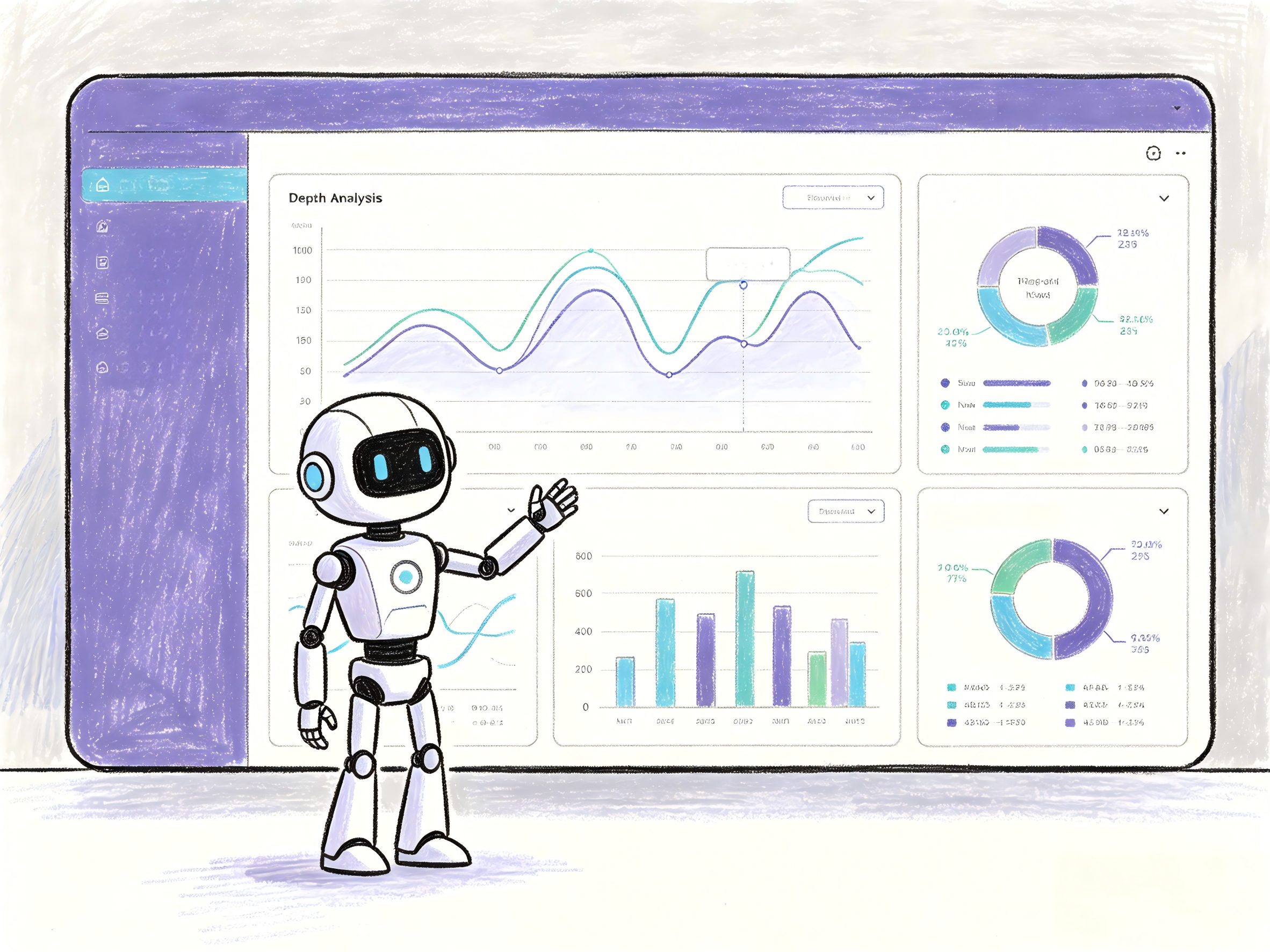
From Deep Data Analysis to Premium Slides, Agentized
Data has never been more abundant. Every team today generates it continuously through customer interactions, revenue operations, product usage, marketing campaigns, and internal workflows. Yet despite this abundance, turning raw data into useful insight remains surprisingly difficult.
Most companies don’t have a data shortage. They have an analysis bottleneck.
Business questions emerge every day:
- Why did growth slow last quarter?
- What caused churn to increase in a specific segment?
- Which customer behaviors changed most recently?
- Where is revenue shifting across channels or geographies?
- What should the team do next?
Finding reliable answers often requires a long chain of work involving spreadsheets, SQL queries, dashboards, manual chart building, report formatting, and multiple rounds of interpretation. What begins as a simple question quickly becomes a multi-tool workflow across analytics, business intelligence, and presentation software.
For many teams, the hardest part of data analysis isn’t accessing the data. It’s transforming that data into something clear, trustworthy, and shareable.
That’s why we built BayesLab.
BayesLab is an AI data analysis platform designed for people who need deep analysis but aren’t professional analysts. It combines automated data analysis, data visualization, report generation, and storytelling into a single workflow.
Upload raw data, and BayesLab automatically cleans, structures, analyzes, and turns it into a complete analytical narrative, including charts, key findings, recommendations, and presentation-ready outputs. What once took hours or days across multiple tools can now happen in minutes.
But speed was never the only goal.
The bigger opportunity, in our view, is to rethink how analysis itself gets done.
Why Traditional Data Analysis Workflows Break Down
Modern data tools are powerful, but they remain fragmented.
Spreadsheets are flexible but difficult to scale. Business intelligence dashboards are useful for monitoring known metrics but often struggle with open-ended questions. SQL is powerful but inaccessible to most business teams. Presentation tools help communicate results, but only after analysis is already complete.
As a result, analysis often becomes disconnected across multiple systems.
Raw data lives in one place. Cleaning happens in another. Exploration happens elsewhere. Charts are copied into slides. Insights are rewritten manually into reports. Dashboards are rebuilt repeatedly when new data arrives.
The process is rarely continuous.
This creates friction not only for analysts, but for anyone who depends on data to make decisions. Product managers, operators, marketers, startup founders, strategy teams, and executives all need insights, yet many remain blocked by technical workflows or limited internal resources.
Deep data analysis shouldn’t require becoming a data analyst.
BayesLab as an AI Data Analyst
We built BayesLab around a simple idea: analytical thinking should be accessible to everyone.
Rather than functioning as another dashboard tool or another ChatBI interface, BayesLab acts more like an autonomous AI data analyst. It handles the operational work behind analysis while preserving the reasoning process.
From raw CSV files, spreadsheets, exported reports, or unstructured datasets, BayesLab can move through the full analytical pipeline:
- data cleaning and transformation
- schema understanding
- exploratory data analysis
- root cause analysis
- dimensional analysis
- forecasting and prediction
- data visualization
- automated report generation
- dashboard creation
- presentation-ready slide output
Each step is connected inside one workflow rather than scattered across separate tools.
This makes BayesLab particularly useful when working with incomplete, messy, or ambiguous data. Most real-world analysis doesn’t begin with perfectly structured datasets or precisely defined questions. It starts with uncertainty.
A user uploads data and asks:
- “What changed last month?”
- “Why are conversions down?”
- “Which customer segment is driving growth?”
- “What are the most actionable insights here?”
BayesLab is built to answer from there.
From Automated Data Analysis to Data Storytelling
One of the most overlooked parts of analytics is communication.
Generating numbers is not the same as generating understanding.
Even the strongest analysis often stalls before action because results are difficult to communicate clearly across a team. A useful chart still needs context. A dashboard still needs interpretation. A report still needs narrative.
Data alone rarely drives decisions.
What drives decisions is data storytelling: the ability to turn analysis into a clear explanation of what happened, why it happened, and what should happen next.
BayesLab was designed with this principle at its core.
Every output is structured not only for analytical accuracy, but for communication. Charts are paired with insights. Insights are organized into reports. Reports are formatted into presentation-ready materials that can move directly into internal reviews, strategy meetings, board decks, or client presentations.
The goal is not just automated analytics.
The goal is actionable understanding.
Reproducible Analysis, Without Rebuilding Everything
Another challenge in modern analytics is repetition.
Teams frequently rerun the same analyses every week, month, or quarter using updated data. Revenue reviews, marketing performance summaries, customer cohort analysis, retention reporting, and operational dashboards often follow the same logic repeatedly.
Yet the work itself often gets rebuilt from scratch every time.
BayesLab approaches this differently.
Once an analytical workflow is created, it can be rerun instantly with new data using the same structure and reasoning framework. The analysis refreshes automatically. Charts update. Reports regenerate. Insights evolve with the latest inputs.
This makes analysis reproducible, scalable, and dramatically faster.
Instead of rebuilding work, teams can build momentum.
The Future of AI-Powered Analytics
We believe the future of business intelligence and data analysis software will feel very different from today.
It will not be defined by who can write the most SQL. It will not be limited to data teams. And it will not require hours of manual spreadsheet work before insight appears.
The next generation of analytics will be agentized.
AI will increasingly handle the mechanical parts of analysis: cleaning, crunching, charting, summarizing, and reporting. Human teams will spend less time preparing data and more time making decisions from it.
In that future, the value shifts from building dashboards to generating understanding.
That is the role we imagine for BayesLab.
BayesLab is built as an AI analytics platform for deep data analysis, automated reporting, data visualization, dashboard automation, and presentation-ready storytelling. It helps teams move from raw data to clear insights, and from insights to decisions, with far less effort.
No Excel dependency. No SQL bottlenecks. No waiting for analysis cycles to finish.
Just data, reasoning, and communication in one continuous workflow.
We built BayesLab for people who need analysis, but aren’t analysts.
Try Bayeslab for Free and experience Agentic Data Analysis today.